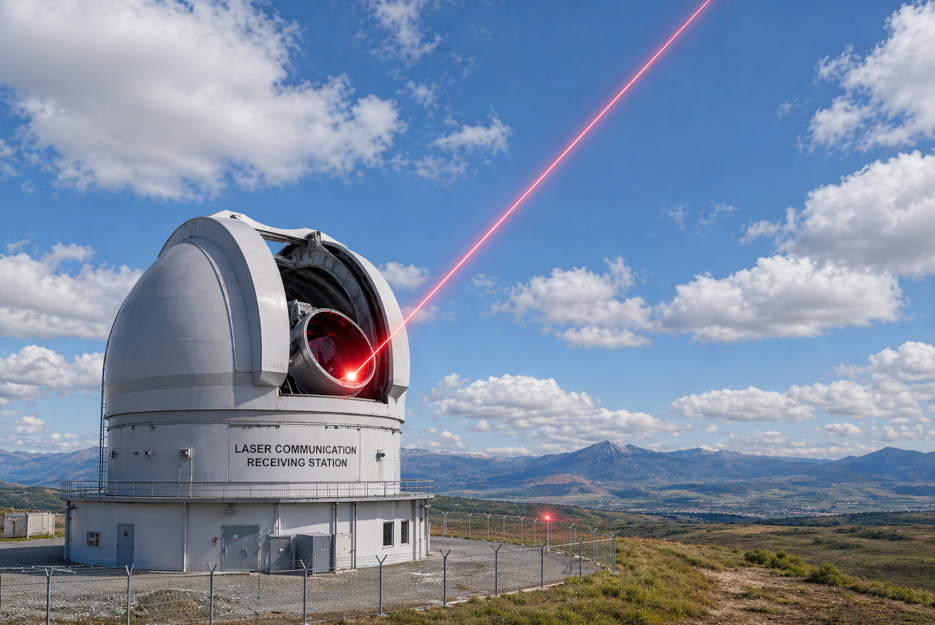
The race for high-bandwidth data transfer has moved beyond traditional radio frequencies. We are currently witnessing a “Laser Revolution” in space communications. Free Space Optical (FSO) links offer data rates 10 to 100 times faster than RF. While using it in space-to-space comm is a no brainer, they face a formidable, translucent enemy: the clouds.
In the world of optical communications, the most critical metric for success isn’t just power, pointing or precision, but the ability to get through the atmosphere.
Observing and forecasting Cloud-Free Line-of-Sight (CFLOS) has evolved from a niche military research topic into a critical commercial service for the burgeoning FSO and laser communication industries.
The CFLOS Bottleneck
Unlike radio waves, which can pass through most atmospheric conditions, the infrared lasers used for optical comms are easily scattered or absorbed by clouds. For a satellite to talk to a ground station, the path must be clear. This creates a massive “availability” problem. If a ground station is blocked by even a thin layer of cloud, the link is severed.
Solving this doesn’t just require better lasers; it requires better atmospheric intelligence.
The Ecosystem: Who is Supplying the Solution?
The market for CFLOS is maturing rapidly, divided between those building the hardware and those providing the predictive intelligence.
- The Hardware Pioneers: Companies like Cailabs and Mynaric are developing Optical Ground Stations (OGS) and terminals that can mitigate atmospheric turbulence. Their goal is to make the “straw” of the laser beam as resilient as possible.
- The Network Managers: Organizations like SSC Space and NASA are managing “Site Diversity” networks. By operating multiple ground stations across the globe, they can “hand over” a laser link from a cloudy station in one region to a clear one in another.
- The Intelligence Layer: This is where the real breakthrough is happening. Traditional weather data (2D snapshots) is no longer enough. Companies like Reuniwatt use ground-based infrared cameras to track cloud movement, while Tropical Weather Analytics (TWA) is pushing the frontier with 3D cloud measurements.
Market Growth: A Billion-Dollar Opportunity
The demand for high-speed data is driving a surge in the optical satellite market. Projections suggest the market will grow at a Compound Annual Growth Rate of over 20%, reaching nearly $1.6 billion by 2030.
As the Space Development Agency (SDA) builds out its Proliferated Warfighter Space Architecture and NASA prepares for the Artemis missions, the value of “uptime” has never been higher. For defense and high-frequency trading, even a 5% increase in link availability can be worth millions of dollars in mission success or market edge.
Beyond 2D: Why 3D Data is the Competitive Edge
The next generation of CFLOS forecasting is moving away from “probability tables” and toward Ground Truth 4D geometry. Most current models look at cloud “top-down,” often resulting in false-negative blockages. However, by measuring the vertical structure of the atmosphere—knowing the exact height of cloud bases and the gaps in multi-layered decks—operators can identify “Cloud-Free Vaults” that traditional sensors miss.
This 3D approach allows for:
- Reduced Infrastructure Costs: Building fewer, more strategically placed ground stations.
- Dynamic Scheduling: Knowing exactly when a 60-second gap in the clouds will open to downburst a terabyte of data.
Other Industries
The CFLOS technology will reach many other industries:
- Solar Power: From “Guessing” to Grid Stability: In the energy sector, clouds are the primary source of “intermittency.” A single passing cloud can cause a solar farm’s output to drop by 80% in seconds.
- Remote Sensing for Optical Satellites: Currently, optical satellites (like those from Maxar or Planet) spend a massive amount of time taking pictures of clouds because they “task” their cameras blindly based on 2D models.
- Ground-Based Astronomy: Precision Scheduling – Modern telescopes (like the Very Large Telescope in Chile) cost thousands of dollars per hour to operate.
- Unmanned Aerial Systems (UAS) & Drones: For industrial drone inspections (pipelines, power lines), CFLOS is a regulatory and safety requirement not to mention the military drone operation explosion (pan intended).
The Horizon
As we look toward a future of gigabit-per-second satellite internet and deep-space laser links, the atmosphere is the final frontier. The companies that can best observe, forecast, and navigate the 3D structures of our clouds will be the ones that hold the keys to the next era of global connectivity.